A company that wants to subsist in the tight market of hydraulic
presses must be able to elaborate solutions exceeding what is usual.
Such solutions lend themselves in the field of process integration. The
example of a custom-made hydraulic gap press elucidates how modern press
manufacturers align new ideas with time-tested design concepts thus
giving their machines a versatility not known so far in sheet metal
processing.

|
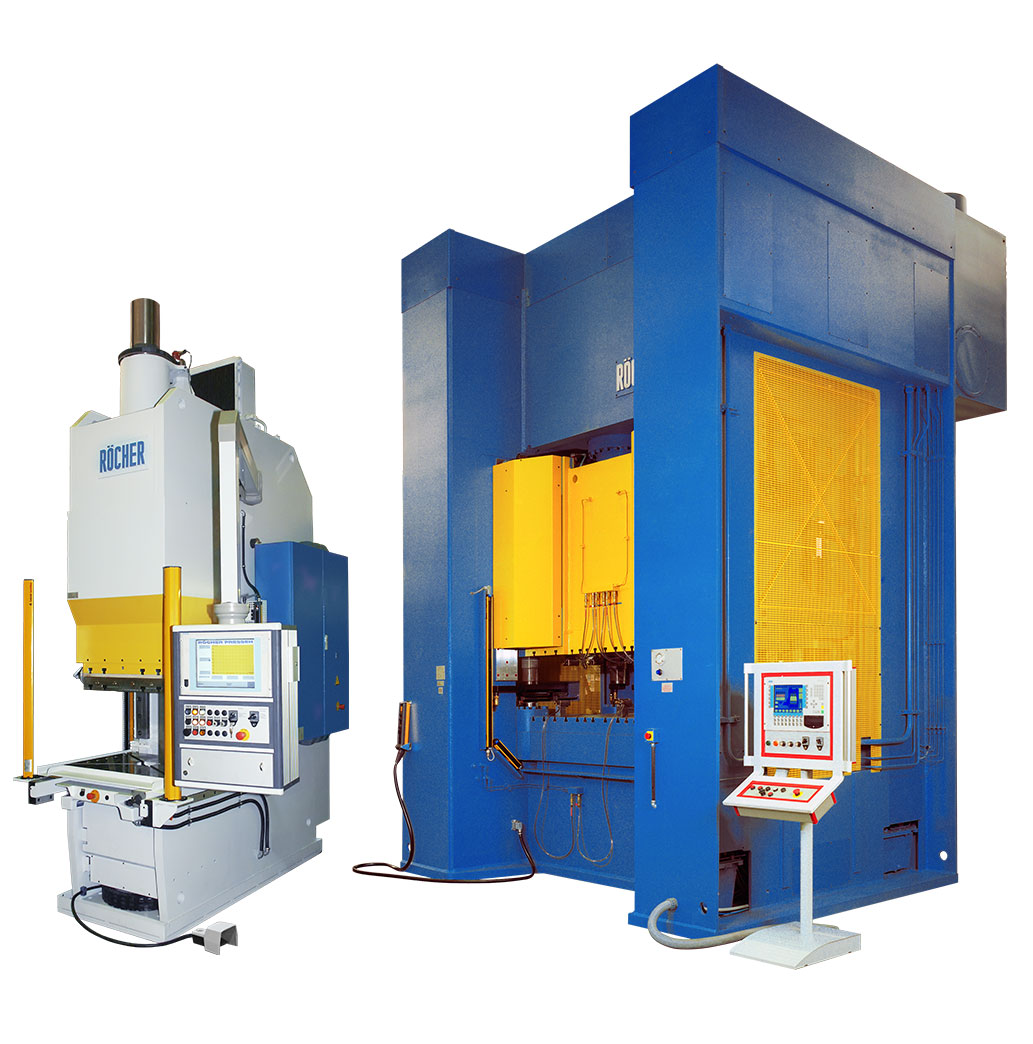
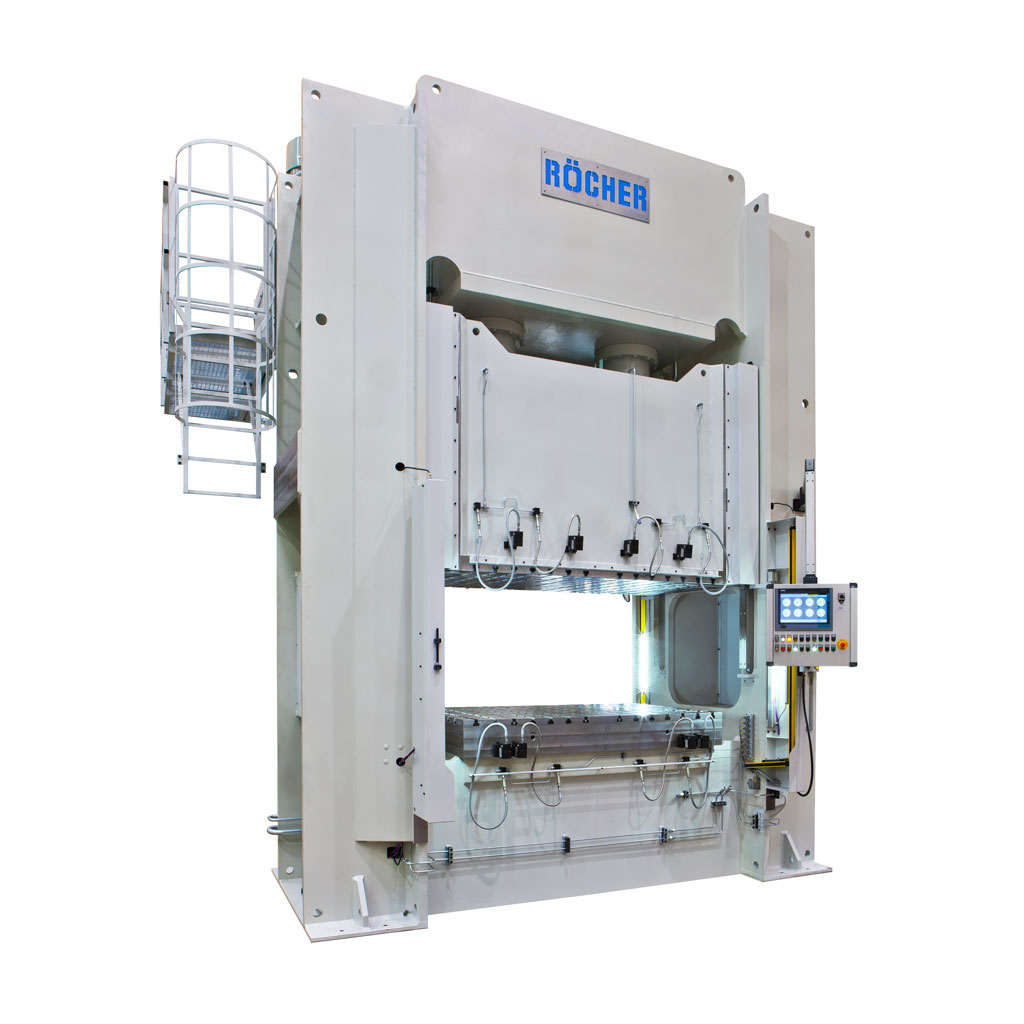
Figure 1, Jack of all the trades:
Hydraulic 1 MN gap press for forming and separating processes from
deep-drawing and punching up to deburring
Users of press technology are nowadays more than ever confronted with
one fundamental economic problem: If they must invest in new machine
tools for the production of innovative products but these new resources
are not completely utilized, then amortization of this investment is
rather difficult. An equally serious imponderability is that it cannot
be exactly anticipated how long these products will maintain their
ground on the market and/or when new or revised workpieces must be
manufactured in addition. In order to avoid outsourcing of the products
to external service providers and nonetheless be in the position to
invest in efficient machine tools, the market nowadays offers universal
hydraulic presses that are able to manufacture a wide range of products
or unite several work processes in one press.
|
Numerous procedures technically realized in a press
As far as the application described hereafter is concerned, the
customer's requirement was to perform different work processes with one
only machine tool. The user was looking for a universal deep-drawing
press that not only realizes the classic forming technique but should
also be able to punch, bend, stamp, size, straighten, insert, border,
cut and deburr. Because of the great variety of parts the component
parts should be loaded manually. Thereupon, the press manufacturer
Röcher, Netphen-Deuz, designed a hydraulic open front press that exactly
meets the defined requirements (figure 1). The machine tool with the
designation – REP 100.01 SZ – has a maximum pressing force of 1,000 kN
and a maximum drawing force of 400 kN. The manufacturer regarded these
two technical parameters as most important characteristic values of the
performance of the machine tool to be sufficient for the planned product
spectrum.

|
Figure 2. Perfect guidance:
Bronze strips that move on hardened tracks hold the ram in its correct
position (guided press carriage principle)
In most designs the active, movable components of a hydraulic open
front press are guided by the cylinder and by additional round guidance
assemblies. Especially in case of presses with long strokes, this may
have an adverse effect, as it is difficult for the guide rods to
compensate eccentric loads in the lower stroke range. In order to avoid
this disadvantage, the design of this universal press is based on a
time-tested basic machine version with guided press carriage. As regards
this version, the ram glides on bronze strips which for their part move
on hardened tracks (figure 2). Bending up can be reduced and possible
eccentric loads absorbed by these guidance assemblies and a robust,
rigid frame construction.
|
Difficult processes well in hand with optimized parameters
In order to remove the workpieces easily and nevertheless efficiently
from the workspace, a hydraulically controlled part ejector is
integrated in the ram that is driven by a separate drive pump. The
advantage of separate drive pumps for the individual hydraulic functions
is a higher precision and a clearer hydraulic control than is the case
with one-piece units.

|
Figure 3. Process at a glance:
The force behaviour during processing is represented in form of a
force-way-diagram.
All forces and positions can be preselected via the machine control.
The positions are optionally programmable with a teach-in function.
The pressing and drawing forces are degressively and progressively
variable via the stroke for best possible arrangement of the drawing
processes under optimized conditions.
Consequently, even difficult drawing processes can be realized with
parameters tuned to each other. In order to control the process, the
force behaviour is displayed in form of a force-way-diagram on the
screen (figure 3). Beyond this, it is possible to document all screen
contents using a commercial printer.
If a machine tool shall be used flexibly and economically, two
criteria are above all decisive: On the one hand the ram speed must be
sufficiently high, and on the other hand the setting times must be
reduced to a minimum. In order to meet the second part of these
requirements, great importance was attached to the tool management when
designing the universal press. So all tool-specific machine parameters
are stored under a tool name or tool number. Each tool must only be
adjusted once. When using the tool several times, the data is then
retrieved from the memory of the control. This minimizes setting times
and avoids part errors.
|

|
Figure 4. Flexible:
During punching, the drawing pad can be moved back hydraulically thus
clearing the pass-through hole
|
Cold or hot forming is possible
In order to ensure that the punching processes are performed
environment-friendly and with high quality, the machine tool is equipped
with a hydraulic snap-through dampening. When performing punching work,
the drawing pad arranged underneath the machine table can be moved back
hydraulically so that the pass-through hole is clear during punching,
and a chute, collecting bin or conveyor belt can be placed under this
hole (figure 4). As the forced sequence of a process not always permits
the maximum working speed, the press was so laid out that the speed can
be infinitely preselected via the control.
This is especially important in case of deep-drawing or bending
processes. Straightening is accomplished using a sensitive electronic
hand lever control. Depending on the movement of the lever, the cam
either moves down or up. To accomplish this, low speed values are
provided so that the operator is in the position to carry out the
process sufficiently exact. The ram speed is controlled proportionally
to the hand lever movement.

|
Figure 5. Keep cool:
A thermal protection plate with additional cooling (at the bottom of the
ram) makes the press a work tool for hot forming.
A further advantage of the universal press: It is laid out for hot
and cold forming. For hot forming, it is only necessary to fit a thermal
protection plate with additional water cooling to the ram (figure 5).
In order to ensure the exact positioning of the ram, the manufacturer of
the universal press has not fitted depth stops that are frequently used
by press operators and need to be adjusted accordingly when making or
reworking tools. In the universal press the fixed stops are replaced by a
stroke limitation (figure 6) integrated in the cylinder and adjustable
via a motor. The position of the mechanical stroke limitation can be
preselected via the press control.
|

|
Figure 6. Rapidly positioned:
The stroke limitation with motor adjustment in the cylinder replaces
fixed stops.
For loading operations, the operating modes can be activated with the
dual palm button control, light curtain, with or without jogging
operation or pedal switch. Although the press owner presently uses the
machine only in the manual loading mode, the automatic operating mode is
nevertheless prepared so that automation is possible later on.
The electric control is based on a "Siemens Simatic S7" and is
operated by means of an industrial PC "Siemens 'PC 670". All standard
functions exist, e.g. preselection of the positions, preselection of the
forces, force or position dependent changeover, force holding times,
pressure relief control for tools with spring pad, high-speed feature or
stroke counter. A steplessly acting mechanical ram locking aims at
maximum safety in case of possible service work on the tool.
As in case of failure of universal core machines no replacement
machines are available, a robust, durable design is of great importance.
For this reason, the universal press described here is equipped with a
compact hydraulic unit. In the event of a failure, the control transmits
an error diagnosis so that the defect can be quickly localized.
Alternatively, the machine tool can be completed with a remote service
connection to the manufacturer so that a rapid error diagnosis through
specialists is possible. The short-term availability of the
manufacturer's service staff is a prerequisite for exhausting the
profitability resources of such a hydraulic press.
|
Processing in a whisper is the declared target
The noise level of machine tools for the processing of sheet metal is
nowadays an import factor for the assessment of a press. Hydraulic
systems are often a disturbance, especially when a machine is located in
a space where many persons are permanently staying but the noise level
is otherwise not high. Special measures taken for sound insulation on
the press reduce the undesired disturbance variables. Use of hydraulic
pumps with low pulsation flow, a hydraulic pump arrangement outside the
hydraulic oil tank and sound insulating measures (figure 7) reduce e.g.
the noise level to a minimum.

|
Figure 7. Please be quiet:
The arrangement of the pump outside the hydraulic oil tank is only
one of the measures taken for sound reduction.
In summary it may be said that hydraulic presses for versatile use
can provide considerable potentials to the user in order to improve the
economic efficiency of his sheet processing processes. A machine
concept as the one described offers numerous future possibilities to
manufacture supplied parts of great variety and with high quality
requirements in a safe process. This ensures long-term utilization of
such investment intensive machine tools.
|